Origins
The original Norman church would have been a small building, probably without a tower, which was most probably added at the beginning of the 14th century. There was expenditure from 1304 to 1307 to enlarge the church, including the new choir, windows, a north door (subsequently walled up), the six westernmost piers in the nave, portions of the tower and a part of the south wall. At this time the church was under the care of the Canons of Bolton Priory. After the dissolution it was given to the dean and canons of Christ Church Oxford who are the present impropriators.
Additional enlargement happened in the latter part of the fifteenth century, when the choir and aisles were extended to the present footprint. The appearance of the masonry supports this, as does the fact that Richard III, who was for some time lord of the castle and honour of Skipton, ordered the payment of £20 towards the repair of the church upon his accession to the throne in 1483.
Civil War
During the time of the Civil Wars, Skipton church was greatly damaged by the Parliamentary forces during the siege of Skipton Castle in the seventeenth century, and the steeple received very rough treatment, being “nearly beaten down by random balls”, referring to the canons being fired upon the castle from the battery on Park Hill as shown on the current OS map.

There was also a secondary site for the cannons, on Cock Hill near Thorlby (approximately a mile and a half as the cannon ball flies!)
The tower was repaired by Lady Ann Clifford, which she did before she started work to the castle which was her home, as she said she would not “dwell in ceiled houses, and let the House of God lie waste.” In her private memoirs, Lady Anne refers to the repairs when she said:
“In the summer of 1655 whilst there she was at Appleby Castle, at her own charge she caused the steeple of Skipton Church to be built up again, which was pulled down in the time of the late wars.” The Lady’s act is recorded upon a tablet which can be found on the north-east pinnacle of the tower which states “This Chvrch & Steeple was repaired by Ye Lady Anne Clifford Covntesse Dowager of Pembrooke &c Ano Dni 1655.”

1700s
In 1766 the steeple was struck by lightning on July 26th, and the weathercock was beaten off as were several of the pinnacles and caused other damage to the whole steeple. The pinnacles had already been repaired in 1751 at a cost of £1 8s. 1d.
1800s
In 1806 George Smith, a native of Skipton, created a painting that occupied the upper portion of the tower arch, and thus divided the ringing chamber from the rest of the church. The subject was “The appearance of the angel to the shepherds of Bethlehem” for which he received twenty guineas. He had also painted the King’s Arms (a painting of the Royal Arms) in 1798 which was upon the north wall near the organ.
In 1836, the pinnacles were repaired again at a cost of £20, and a new weathercock was added in 1841.
On June 19th 1853, during a very severe thunderstorm, the church was once again struck by lightning, during Sunday morning worship. One of the pinnacles of the steeple, weighing a ton and a half, was knocked down and entered the church, filling the church with dust and sulphur, which left the congregation terrified but uninjured. The pinnacle was replaced the following year under the direction of John A. Cory, architect, of Carlisle.
The strike was so powerful it even reached the Manchester Guardian; the Westmorland Gazette carried an abridged copy of their report which is well worth reading in full, but here is a snippet:
“It seems that although the weather had been somewhat close for a day or two, there was no indication of an approaching storm at the time the congregation was assembled; and although distant thunder was heard by persons in the streets, about half-past eleven, those in the church neither heard nor saw anything until sixteen minutes before twelve, when there was a blinding flash of lightning, followed instantaneously by a remarkably loud and continued clap of thunder. Rain fell in torrents for some time afterwards, but there was no more thunder or lightning.
In a pew in a line with the stove on this side, were two ladies named Carr; one of them got a rather severe bruise on the shoulder from a piece of rick, and both were rendered deaf, one of them remaining so up to Thursday. It was stated, and seemed to be generally believed in the town, that several small holes had been burned in the bottom of the dress of one of the ladies; but the statement has no other foundation than the fact that the dress was found to be slightly torn when Miss Carr reached home. The terror of a large portion of the congregation has given rise to most marvellous tales of balls of fire flying about the church – one being described as going so close to the top of the pulpit that it must have killed the minister, had the occurrence happened a minute or two later, when he would have been in the pulpit; another, as darting along the main aisle, under a form upon which some school children had been sitting up to the time of the commencement of the singing; and a third, as passing close over the heads of the singers in the organ gallery
Rev. H. Cooper was in the vestry (at the south west end of the church), after the communion service, heard distant thunder, but as the congregation were singing at the time, nothing was heard in the body of the church. Mr. Cooper was in the act of opening the vestry door, to proceed to the pulpit, when he was blinded, knocked staggering backwards, and rendered insensible for some seconds, by the flash of lightning before mentioned. He was recalled to himself by the terrible screams of the females and children among the congregation (there being an unusually large attendance); and on going into the church he found the congregation rushing towards the doors in a state of the utmost terror and excitement.
Mr. Cooper, aided by some other gentleman, exerted himself to quiet and calm the people; but though they succeeded to some extent, the congregation immediately quitted the church, in which there was no further service during the day. So complete was the terror of some, that they ran through the rain without hats or bonnets, and with their hymn books in their hands, never stopping until they reached their homes, and then remaining for some minutes exhausted and speechless….“
1900s
Some major restorations to the church took place in 1909, when three galleries, described as ugly, were removed and some of their oak panelling re-used to line the lower parts of the walls of the north and south side aisles. The whole of the stonework beneath the tower was cleaned of all paint and whitewash and the stones pointed.

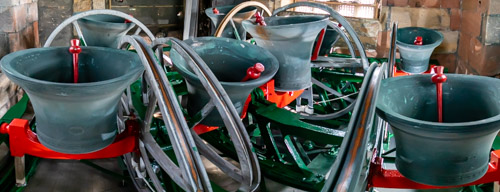
A new oak floor of the ringing chamber was made approximately eight feet higher, resting on the old stone corbels, in order to open up the west end and give a better view of the west window from inside the church. The bellringers were delighted that the floor was several feet higher as it made bell ringing much easier.
A new window was added to the north side of the tower for the ringing chamber and the old entrance to the stone staircase to the belfry was unblocked and a new oak door fitted.