Pre-1750s
It is not known when the church first had bells, but in 1617, the parish register states that “The old bellframe being decayed, a new one was made and finished the 10th September, ao. pd. [year before, or 1616], by Rowlande Tatham, of Ashton.”, so it can be concluded that it had already served for a number of years.
In the parish register dated September 29th 1617, it is recorded that “the third bell was brought the same day.” An addition was made eleven years later that “This year, 1628, the Right Honnerable Francis Earle of Cumberland gave the little bell to the parish of Skipton, with all the wood belonging to the frame where it now hangs.”
The next year, the “chime” was considered finished with the addition of a fifth bell: “The chime was made and finished at the perish charge in this same yeare, one thousand six hundreth twentie and nine, as by recordes it may appeare. Mr Suttonn [Rev. Robert Sutton] was then vicker of Skipton, and Thomas Preston Clarke of the same; Thomas Tomlinsonne and Thomas Glover churchwardens.”
Early in 1643 the siege of Skipton Castle began. The Cliffords, who were strong supporters of the King, were surrounded by parliamentarians, including John Lambert of Canton near Kirkby Malham, who became one of the military leaders of the parliamentary forces. The last Yorkshire castle to fall to the parliamentary forces was Skipton, the stronghold of the Cliffords, and was taken in December 1645. Between 1646 and 1647 Parliament ordered the destruction of eight famous Yorkshire castles, so that they should be rendered incapable of use in war; Knaresborough, Cawood, Middleham, Bolton, Crayke, Helmsley, Wressle and Skipton were all included. The ‘slighting’ was completed at the end of 1648 and Lady Anne Clifford started the work to restore the breaches to the castle in February 1650. It wasn’t until October 1655, after the castle had remained in ruins for seven years, that Lady Anne had the rubbish cleared away and started the restoration of the castle.
At the time of the Civil War, there were five bells in Skipton steeple. Writing in 1733 Gent, the Yorkshire topographer says: “In the Civil Wars the Steeple was almost demolished. The Five Bells were taken as a Prize, and tho‘ agreed to be redeemed for Two Hundred Pounds yet only Four of them were sent back, which are in the present steeple, that was erected (or rather re-built) by the Countess of Penbroke.”
1757
The parish clerk Timothy Crowther became dissatisfied with the peal of bells which had so long occupied the steeple. He complained that they were cracked, and not sufficiently good for a town of such importance as Skipton. Accordingly, he presented himself before the churchwardens and boldly asked that a new peal might be cast. The wardens were astonished at such an extravagant idea. “It is out of the question,” they said to Crowther. The country wardens – the “outen-towners” as they were called – were especially opposed to the proposal, for living away from Skipton they did not benefit much by the bells. Undaunted, the parish clerk modified his request. “I suppose you will not object to buying new clappers?”, he said. “Not at all; that is quite reasonable.”
The story goes that he obtained clappers so large that after the first time of using them, the bells were found to be unmistakably cracked. The changing of the peal of bells was before option but now it was compulsory.
1759
It was not until 1759 that the township decided to purchase new bells. In a resolution of a vestry meeting:
“At a vestry held in the parish church of Skipton pursuant to notice for that purpose, it is agreed that the bells belonging to the parish church of Skipton be exchanged or melted down with other metal into a peal of six new bells; the tenor or largest of which new bells to be eighteen hundredweight or thereabouts, and the other five bells to be agreeable in tune and tone, and in proportion to the said tenor or largest bell. And it is also agreed that the present churchwardens, or their successors for the time being, or the major part of them, do contract with such person or persons for exchanging or melting down the said bells into a peal of six bells in a manner aforesaid, and for hanging and carriage and other special matters relating to the same as they shall think proper. As it is also agreed that a subscription be set on foot throughout the parish of Skipton in order to raise a sum of money for defraying the expenses of founding and hanging the said six new bells and other matters relating the same, and if such subscription shall happen to fall short of defraying the said expenses, it is then agreed that a sum of money be borrowed on some person or persons on the credit of the inhabitants of the said parish of Skipton, to make up the deficiency of till the same, together with interest form the time of the borrowing, can be conveniently raised and paid by an assessment on the inhabitants of the said parish, which assessment is hereby agreed shall be paid. As witness our hands this twenty-third day of September 1759. Walter Priest, vicar of Skipton; S Plomer, George Demaine, Francis Atkinson, Hugh Tillertson, Thos. Heelis, Wm. Chippendale, Henry Atkinson, William Myers, William Atkinson, John Chippendale, churchwardens.”

Towards the cost of the bells the following voluntary subscriptions were received:
| £ | s. | d. | |
|---|---|---|---|
| The Earl of Thanet | 50 | 0 | 0 |
| The Duke of Devonshire | 20 | 0 | 0 |
| Mr Collins | 1 | 0 | 0 |
| Skipton subscriptions | 65 | 8 | 0 |
| Stirton and Thorlby ditto | 9 | 4 | 6 |
| Embsay ditto | 4 | 13 | 6 |
| Draughton ditto | 3 | 12 | 0 |
| Halton and Bolton ditto | 4 | 9 | 0 |
Assessments and the sale of old material brought up this amount to £293 17s. 3d., the total cost of the new bells with the expense incurred in hanging them. The ‘little bell’ was sold to the churchwardens of Rilstone for £15.
1887
Two further bells by James Shaw, Son and Co. Of Bradford were added in honour of the Jubilee of Queen Victoria, at a cost of £150, which was raised by public subscription. These were the two lightest bells of the then set of eight as shown on the inscription board.
The total weight of this peal of eight bells was 75 cwt (3,810 kg).
1920
By 1920 the bellringers had started to complain that the bells were out of tune and difficult to ring. It was therefore decided to recast the bells and fit a new bell frame. An article in the Nelson Leader, on 20th August 1920, reported:
“An expert has examined the Skipton Parish Church bells, and reports that both the bells and the frame on which they hang are in urgent need of repair. Some of the bells it is impossible to ring, and others are sadly out of tune. Six of the bells were placed in the tower in 1760 on the oak frame, which still exists, so there is little cause for wonder that there is need for renovation. It is intended to put the bells into perfect ringing order by the substitution of a steel frame for the old oak one, and to have the bells recast and tuned. For this purpose a sum of around £1,100 is required and an appeal for subscriptions is shortly to be issued to the public of the district.”
1921
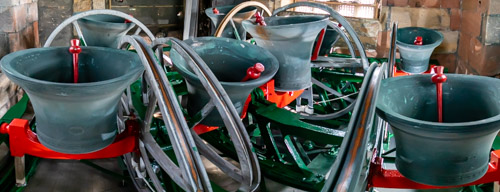
In early 1921 the old peal of eight bells were taken out and recast into a new peal of eight by John Taylor and Co, of Loughborough. They also made a new bell frame of steel. They had, in fact, wanted to make it out of cast iron with steel supports, but the church authorities insisted on the cheaper all steel bell frame. Taylor’s also made a new floor for the bell chamber, having removed the old one.
They also re-fixed all the clock hammers, re-fitted the sanctus bell (fixings only, no rope), and the flagpole. To get the old bells out and the new bells in, a mason was also employed to remove and replace the window mullions.
The total weight of this peal of eight bells is 86 ½ cwt (4,394 kg). The heaviest, the tenor, weighs 22 ½ cwt (1,143 kg). The bells were tuned to the harmonic principal laid down by Canon Simpson of Sussex.
The total cost of the new peal of bells and the bell frame was £1,310 (the equivalent would be about £60,000 today). This was collected by subscriptions and donations.

Courtesy of Craven Museum
The churchwarden kept a book of each donation, and the front cover and one of the pages are shown here:

