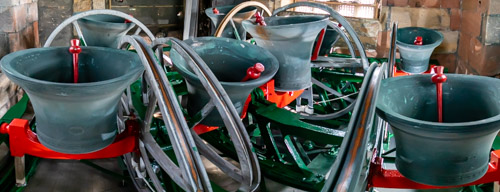

John Taylor and Company have been making bells since 1784, and have been based in Loughborough since 1839, and is now proud to operate the largest bell foundry in the world. They produce single bells, peals of bells, chimes and carillons, together with sets of musical handbells and other small bells for customers worldwide.
They were chosen to recast the bells at Skipton, and the man who ran the company at that time was Pryce Taylor. The John Taylor Bellfoundry archive have kindly supplied the job book entries for the work on the Skipton bells, one of which is shown here. It shows the job was completed on 30th July 1921.
The bellfoundry archive shows that the old bells arrived at the foundry on 29th March 1921, and the casting was done on April 6th (the 3rd and the tenor) April 26th (the 2nd, 5th, 6th and the 7th) and May 10th (the treble and the 4th). The old tenor went into the melting pot on the 10th May and the others on various dates up to the 23rd June.
The new bells left the foundry on July 15th 1921, and the invoice shows that the old bells in total weighed 75 cwt (3,810 kg), and £5 per cwt was paid for the metal, a total of £375. The new bells cost £10 per cwt, a total of £820.

Courtesy of The John Taylor Bellfoundry Archive
In addition to the casting of the bells, the invoice shows that Taylor’s also undertook the following:
- Fitting of the bells and the new frame
- Taking down the old floors and fixings
- Carriage
- Refitting the clock hammers and connections
- Refitting the flagpole and the sanctus bell (new fittings, no rope)
- New floor under the bells, involving both a plumber and a joiner
- Mason to remove and refit the window mullions and ‘letting in guides’
- Inscriptions, 446 letters at 6d each

Courtesy of Craven Museum
The Craven Herald reported that craning the bells into the belfry was completed on Wednesday 27th July and work was underway to fix them to the new frame.
Pryce Taylor, Bell Founder
Pryce Taylor was born in Loughborough, Leicestershire, in 1891 the son of John William Taylor and Annie Mary Taylor. He lived his early life with the family at The Bell Foundry House, Loughborough.
During the first world war, he had enlisted with the Royal Fusiliers originally but shortly after was transferred to the Leicestershire Regiment having gained a commission as a Lieutenant. He saw service in France & Flanders with his regiment and later with the Machine Gun Corps. During this time, he received a gunshot wound to his arm. His final posting was with the Royal Engineers from whom he was discharged and awarded the Victory and British War Medals. Of his brothers, Arnold Bradley Taylor, Gerald Bardsley Taylor and John William Taylor, were all killed in action.

Photo courtesy of The John Taylor Bellfoundry Archive
He and his wife Kathleen sailed from Liverpool to New York on the Cunard ship SS Scythia, arriving on 12th April 1927. He attended the opening of a large carillon which Taylor’s had made for Germantown, Philadelphia. They visited a number of cities but in Toronto he was taken suddenly ill and removed to the Wellesley Hospital, where peritonitis was diagnosed, and an immediate operation was deemed necessary. This was performed, and, though the best was hoped for, the case was apparently hopeless from the first and he died aged 36, on 15th July 1927.
Kathleen returned to Southampton on 26th July 1927.