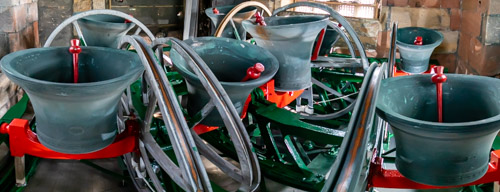
After the bells were rehung at the end of July 1921 an inauguration service was held, and the bells rung for the first time on Saturday 6th August 1921. This is the article from the Craven Herald on Friday 12th August 1921 , and at the bottom is an article from the bellringers’ journal.
| SKIPTON CHURCH BELLS DEDICATED BISHOP OF BRADFORD’S HISTORICAL SURVEY AN IMPRESSIVE SERVICE. The history of the Skipton Parish Church, which brings the reader within arm’s length of the Norman Conquest, centres largely around the organ, the porch, the font. the tower, the bells, the clock and the Clifford tombs. The present clock, made in 1835, and the porch, erected in 1800, are the most important acquisitions of the nineteenth century. Whatever improvements or additions the present century has yet to witness, the recasting and re-hanging of the bells – a work which has occupied the period between March last and the present month – must rank as the primary event. Much has appeared in the “Craven Herald” during recent weeks bearing on the history of the bells cast in 1759 by Lester and Pack. of London, and now re-moulded and hung on an improved frame by Messrs. John Taylor and Co., of Loughborough. Reference has also been made in detail to the present scheme for re-casting and re-hanging the peal, and little remains to be told save the facts of an impressive service held at the Parish Church on Saturday afternoon last when the bells were dedicated by the Bishop of Bradford (Dr. A.W.T. Perowne). The ceremony was performed in the presence of a crowded congregation. The choir was in attendance, and Mr. Turner Smith presided at the organ; while the devotional portion of the service was in the hands of the Venerable Archdeacon H. L. Cook (rector) and the Rev. W. M. Lister (curate). In addition to a shortened form of evening prayer, special prayers relating to the bells were said. and the following hymns were sung:- “Christ is our cornerstone,” “Angel Voices, ever singing,” and “When morning gilds the skies.” Prior to the singing of the last-mentioned hymn, the dedication took place, the Bishop, accompanied by the churchwardens, clergy and choir, proceeding to the base of the tower for the purpose. As senior churchwarden, Mr. A. Randerson requested the Bishop to dedicate the bells “to the service of God and the benefit of His Church,” and his Lordship responded in a brief sentence of dedication. The Bishop then gave a sign to the ringers already at their stations in the bell-chamber, and the congregation stood whilst a brief peal was rung. An integral Part of Church Life. The Bishop subsequently delivered a sermon dealing mainly with the civil and religious uses to which bells were put and based on Proverbs, chap. viii. v. 4 – “Unto you, O men, I call; and my voice is to the sons of man.” He described that day as one of great importance to the members of the Church, as they had come once again into what was really an integral part of their church and home life. Church bells, he went on, were not in use in England until the seventh century according to the chronicler Bede and the Abbot Wearmouth who introduced bells into his abbey in 680. It was not, however, until a great deal later that bell-casting became the fine art it was to-day. In the sixteenth century some very fine work in this direction was done in Holland and Belgium, whence we received most of our most ancient bells. It was quite clear that early in the history of our churches land church-building, bells played a very important part, because it was held by archaeologists that church towers were built not for ornamentation but as a domicile for the bells. Turning to the uses of church bells, Dr. Perowne said they still existed in places – Antwerp, for example – where the citizens had rights in respect of certain bells. The chief bell in Antwerp Cathedral belonged to the burghars of the city and not to the Cathedral Chapter, and the title to ownership was very jealously guarded. In political history, bells at one time had their uses in so far as they were melted down by the conqueror of a city to mark his triumph, or were cast by citizens from the canon of a vanquished enemy. Some of the great events in history, observed the Bishop, had been marked by the ringing of bells, and he mentioned the simultaneous ringing of the bells of Paris as a signal for the Hugenot massacre in 1571 as a stirring example. Latterly, he added, Armistice Day and Peace Day were marked by jubilant peals, while in Dublin the curfew had been employed for a far more solemn and sinister purpose. Skipton’s Curfew and Angelus. Touching on the religious significance of church bells, the Bishop observed that in this connection their functions were most important. He mentioned the Ave Maria bell rung at early morning, and in alluding to the Angelus, commented in terms of satisfaction upon the fact that at Skipton the Angelus bell was still rung at noon and again at night in the form of a curfew. There were also the bell still used to mark the consecration of the elements in the Holy Communion and the Passing Bell “to make men know that another soul has passed, or is passing, into the hands of its Maker.” Dr. Perowne proceeded to observe that the ringing of church bells was a divine call to prayer. He had been much impressed on two occasions recently by the measure in which the Sunday morning chimes had appealed to certain men in the diocese whom the calls of business in Bradford prevented from attending divine service. “The bells helped those men to realise that their clergy were praying for them, and assisting them to do the hard thing in business, with an eye upon God himself.” Bells, he went on, were also a call to worship. He was thankful that that day had been marked in the revised prayer book by the restoration of the Festival of the Transfiguration, and it was very striking that upon that day also the Skipton Parish bells should have been dedicated. Collectors and Ringers. At the close of a service a collection for the benefit of the bells fund realised £20, and the proceeds of a flag day held in the town on Saturday and set apart for the same fund, amounted to over £43. The flag day was organised by the ringers connected with the Church, and the following is a list of the collectors :- Mesdames Anderton, Scott, Billows, Bailey and Waller; Missess A. Hillary, N. Hillary, E. Schneider, D. Randerson, Ross, Core, Clarkson, Wiseman, V. Wood, Green, Moorby, Knowles, Cowgill, D. E. Barrett, L. Smith, Judson, Mathers, Gough, Alderson, Pawson, Bargh, M. Procter, Williamson, Brown, Clarkson and Clifton; and Mr. A. Randerson. In addition to the rounds rung immediately following the dedication, the bells were rung later in the afternoon and again in the evening, the “touches” including 600 changes. Grandsire Triples, and Kent Triple Bob Major. The following ringers officiated:- Skipton Parish Church – Misses A. Hillary and E. Moorby, Messrs. W. Billows. W. D. Hillary, H. Horner, J. Garlick, W. Bailey, A. Lawson, E. Metcalfe (Ripon Cathedral), F. Metcalfe and P. Taylor (Messrs. J. Taylor and Co., Loughborough). – St. Andrew’s Church, Keighley. – Messrs. R. W. Jennison, J. Edmondson, H. Green, E. Green. S. Murgatroyd, J. Hall, A. Jackson. R. Bottomley, and the Rev. M. C. Edgar (St. Augustine’s, Kilburn, London). – St. Andrew’s Church, Gargrave – Dr. H. Wales, Messrs. H. Birtwhistle, C. Langstroth, J. Langstroth, W. Bradley and J. Bazley. – St. Andrew‘s Church, Kildwick – Messrs. C. Brown, H Roe, C. Law, E Lambert and S. Tillotson. – St. James’s Church, Silsden – Mr. J. Cooper. Preaching at the Skipton Parish Church on Sunday evening, the Venerable Archdeacon H. L. Cook interestingly outlined the earlier history of the bells. |
