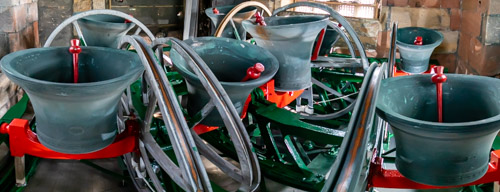
When bells are cast it is usual to add an inscription, often the name of the donor. Holy Trinity’s bells were cast in 1921 and the board shown here hangs upstairs in the ringing room, showing what is on the inscriptions.

Treble
“Given by THE STAFF AND PUPILS OF THE SKIPTON GIRLS’ HIGH SCHOOL”
In “The Old Girls’ Guild Magazine” for 1920, can be seen information on how the school raised funds for this bell:
“When the School heard that the peal of bells at the Parish Church were to be recast and rehung at great expense, it undertook to raise the money for the E flat bell, which will cost £69. Form IVA. gave an entertainment, consisting of songs, dances, gymnastic display and scenes from Shakespeare’s Merchant of Venice, which raised £12.
The Hostel and Hillside gave two performances of a very pretty cantata, realising £15, and Miss Windsor, with her usual energy and originality, made £26 in an hour by means of a rummage sale in Millfields School. We have every confidence that we shall complete the sum required by the time this magazine is in the hands of its readers.”
In the 1921 magazine, it says:
“At the beginning of the year the Fifth Form gave two performances of “As You Like It,” the collections at which amounted to about £15, and completed the sum of £69 which was raised by this School to re-cast and re-hang the E flat bell of the Skipton Parish Church peal.
The beautiful tone of the newly hung bells has been a great joy to Skipton.”
2nd
“Given by THE WOMEN’S HELP SEWING PARTY”
Part of the church, this group held bible classes on a Thursday evening in the vestry and a sewing party on a Tuesday in the parish room.
3rd
“Given by PUBLIC SUBSCRIPTIONS ALSO BELLS 5, 6 & 7.”
A total of £823 0s. 7d. was raised in total by public subscription.
4th
“Given by THE SKIPTON PARISH CHURCH SUNDAY SCHOOL TEACHERS”
5th
“In memoriam
FRANK C. BILLOWS
AND
ROBT. BARKER”
The inscription on the 5th bell records the names of two of the bellringers, Frank Billows and Robert Barker who were killed in the Great War.
6th
“W. BILLOWS, J.G. GARLICK, W.D. HILLARY, A. LAWSON, H. HORNER,
ADA HILLARY, W.BAILEY, EVELYN MOORBY,
Ringers”
Three of the eight ringers named on the 6th bell were in the same family. William Billows, his brother-in-law William Downham Hillary, and William’s daughter Ada Hillary.
7th
“REHUNG AFTER RECASTING IN MAY 1921,
HENRY LUCAS COOK, M.A. Rector.
WILFRED M. LISTER, M.A. Curate,
STEPHEN ANDERSON, ARTHUR RANDERSON, ROBERT CARY FISHER, Churchwardens.”
Tenor
“Given by THE LATE A.H. DAWES AND HIS WIFE. Christ Church Contribution £50”
Alexander Henry Dawes was born in Manchester in 1857 and was the bank manager of the London City & Midland Bank. Yorkshire Banking Co’s premises replaced two old shops which were demolished in 1888 (the date on the building can be seen today) and was opened on the 11th September 1889. In 1901 this Company amalgamated with the London City and Midland Bank Ltd, which in 1918 changed its name to the London Joint City and Midland Bank Ltd, and in 1923 to the Midland Bank Ltd, and now it is the HSBC.
He married Constance Ada Wrigley at Holy Trinity, Skipton on 22nd July 1884, when Constance was 20 years old and Alexander was 27 and a bank clerk.
In the 1901 census, they are shown living at ‘Bank House, High Street, Skipton’, as part of the Yorkshire Bank Buildings, Alexander aged 44, and Constance aged 36, along with two servants, a cook (Margaret, aged 20) and a housemaid (Alice, aged 20). In the 1911 census, they are still shown living at ‘Bank House, Skipton’. He (aged 54) and his wife Constance Ada (aged 46) from Todmorden were married for 26 years and had no children, but the house had 11 rooms and they shared it with an Aunt (aged 76) and two servants, a cook (Isabel, aged 22) and a housemaid (Rose, aged 24). From 1894 to 1915, Alexander is shown on the electoral register for Skipton, when his address is simply ‘High Street, Skipton’.
On 31st August 1917, he retired from the bank (succeeded by Douglas E Wilson) and moved to Southport after being the manager for 26 years, from 1891 to 1917, successor to J.H. Howarth, who was one of the principle workers to secure the free library.
Constance Ada died on 21st November 1920 of “carcinoma of the uterus and exhaustion” aged 56 and was cremated at Liverpool Crematorium on 24th November 1920. Alexander Henry died on 22nd December 1920, of “Cerebral haemorrhage – Coma”, aged 63 and cremated one month after Constance on 24th December 1920. His death was registered by the son of his half-sister, who was his nearest surviving relative. Alexander left £12,011 in his will, including £1,000 to “the rector and church wardens for the time being of the parish church of Skipton aforesaid to be expended by them on the purchase of bells or organ or on their repair”.